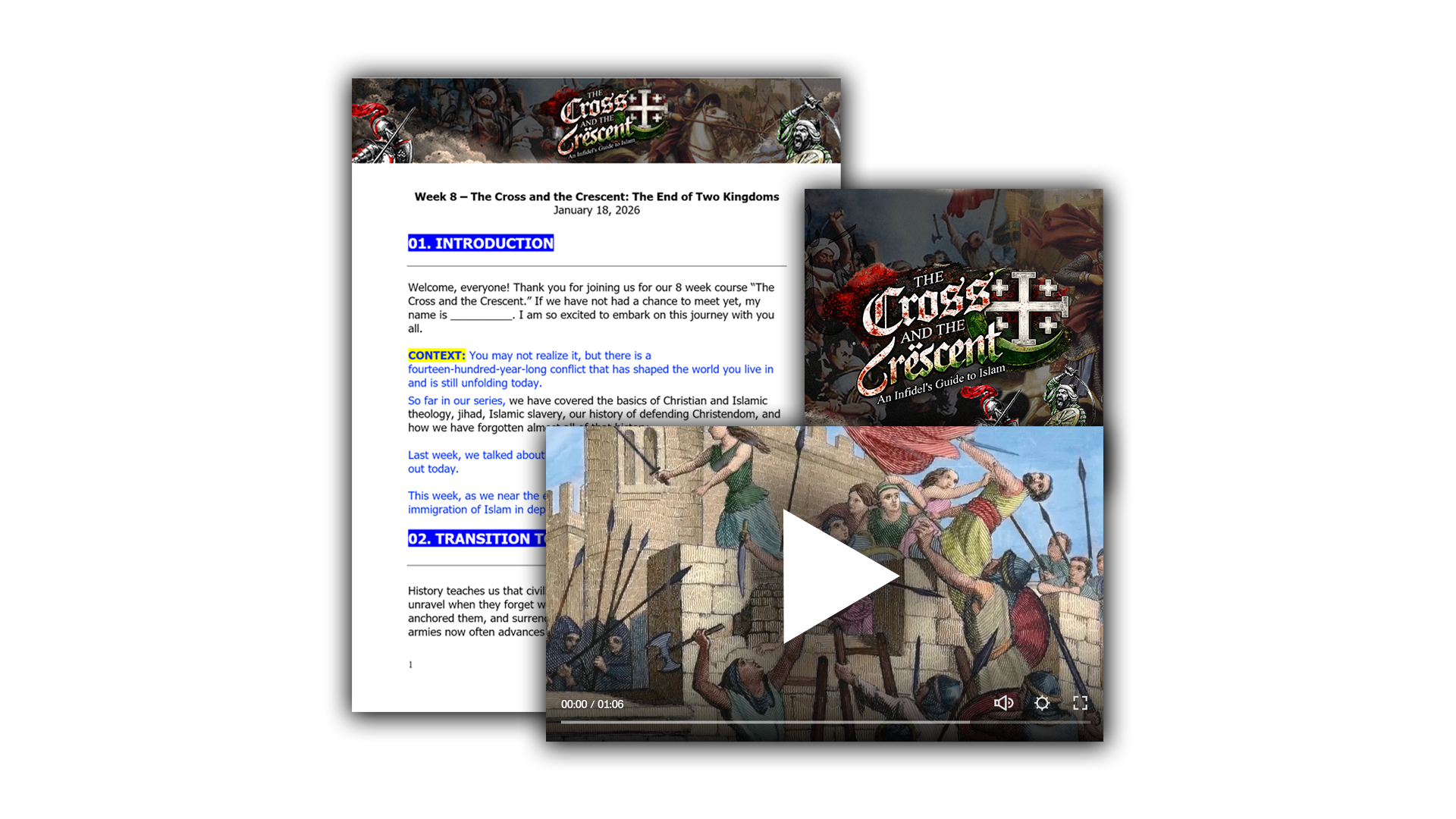

The Cross and the Crescent is a ten-week teaching series designed to equip Christians with theological clarity, historical memory, and cultural discernment regarding Islam and its long conflict with Christendom.
This course argues that Islam is not merely a private faith but a comprehensive system that unites theology, law, and power. By contrasting Christian and Islamic doctrines, tracing fourteen centuries of history, and examining current events in the West, believers will be prepared to respond boldly and without fear.
-
Part 1 — Christ’s Kingdom and the True Gospel
Christ’s kingdom advances through repentance and belief, not coercion
The spiritual battle is against evil, not people
The Church’s weapon is truth, not force
Part 2 — The Birth of Islam
Islam historically united religion, law, and political power
Expansion occurred through conquest across historic Christian lands
Theological conflict between competing kingdoms and loyalties
Part 3 — Modern Implications
Christians must recover historical awareness
Believers are called to defend their faith and remain vigilant
Education and discernment are necessary for spiritual preparedness
-
The lives of Muhammad and Jesus side by side could not be more different; through the lens of history, character, and the fruit of their teachings. By examining their actions, message, and legacy, this message explores the difference between the claims of Islam and the gospel of Jesus Christ.
-
The Bible and Quran side by side could not be more different; through the lens of history and the fruit of their teachings.
-
Part 1 — Theology of Jihad
Jihad framed as obedience within early Islamic theology
Warfare historically connected to religious expansion
Distinction drawn between Christian and Islamic views of war
Part 2 — Historical Expansion
Rapid territorial loss of historic Christian regions
Conquest reshaped political and religious demographics
Establishment of dhimmitude systems under conquest
Part 3 — Scriptural Warnings
Believers must actively guard what God entrusts
Faithfulness requires vigilance and responsibility
Forgetting history leads to vulnerability
-
Part 1 — Christian Theology of Freedom
God revealed as liberator throughout Scripture
Human dignity rooted in the image of God
Freedom fulfilled in Christ’s redemptive work
Part 2 — Dhimmitude and Subjugation
Historical systems of religious hierarchy under Islamic rule
Legal and social subordination of non-Muslims
Contrasts between biblical liberation themes and subjugation systems
Part 3 — Modern Implications
Freedom defined spiritually as well as politically
Discernment required when evaluating belief systems by their fruit
Christians called to stand courageously in truth
-
Part 1 — The Battle of Tours (AD 732)
Islamic expansion moved into Western Europe
Charles Martel led defensive resistance that halted expansion
Faithful resistance preserved Christian lands and future generations
Part 2 — The Battle of Lepanto
Christian unity across nations confronted naval expansion
Prayer, cooperation, and leadership were central to victory
Demonstrates the role of collective faithfulness in preservation
Part 3 — The Siege of Vienna
Defense of Europe prevented further territorial expansion
Courage and sacrifice protected future generations
Historical reminder that obedience sometimes requires standing firm
-
Part 1 — Demographic and Institutional Change
Civilizations may change through demographic shifts rather than conquest
Loss of shared identity weakens societal cohesion
Cultural confidence tied to spiritual foundations
Part 2 — Case Studies of Institutional Failure
Examples cited of governmental and institutional inaction
Emphasis on protecting vulnerable populations
Moral responsibility of leaders and societies to confront injustice
Part 3 — Lessons for Believers
Silence allows injustice to multiply
Truth-telling presented as moral obligation
Faith communities called to courage and discernment
-
Part 1 — Forgetting God Precedes Collapse
Cultural decline begins with spiritual decline
False confidence replaces repentance and dependence on God
Pride and self-reliance weaken societies
Part 2 — Secular Humanism Rewrites History
Western civilization moved from revelation-based truth to relativism
Historical narratives increasingly detached from Christian foundations
Identity confusion follows the loss of shared truth
Part 3 — Amnesia Enables Cultural Vulnerability
Forgetting history allows ideologies to be whitewashed
Memory functions as cultural protection
God commands remembrance as an act of faithfulness
-
Part 1 — Taqiyya: The Doctrine of Concealment
Defined as concealment or dissimulation under certain conditions
Historical theological discussions around strategic deception
Biblical contrast emphasizes truthfulness as moral foundation
Part 2 — Historical Continuity
Twentieth and twenty-first century examples of religiously motivated violence
Continuity between doctrinal belief and modern events
Importance of evaluating beliefs by their outcomes
Part 3 — Modern Application
Discernment required when evaluating ideological systems
Testing spiritual claims is presented as biblical responsibility
Christians called to pursue truth rather than fear
-
Part 1 — Cultural and Spiritual Decline
Civilizations collapse when foundational truths are abandoned
Loss of moral courage leads to institutional weakness
Spiritual issues viewed as underlying political problems
Part 2 — Modern Case Studies
Examination of societal examples intended to illustrate institutional breakdown
Focus on justice, protection of the vulnerable, and moral accountability
Analysis framed around long-term civilizational change
Part 3 — Final Call to Faithfulness
Believers urged to maintain truth, courage, and conviction
Cultural preservation connected to spiritual obedience
Emphasis on vigilance, stewardship, and moral clarity
Watch the Full Series Here!

Why the Church Must Hold the Line for the West
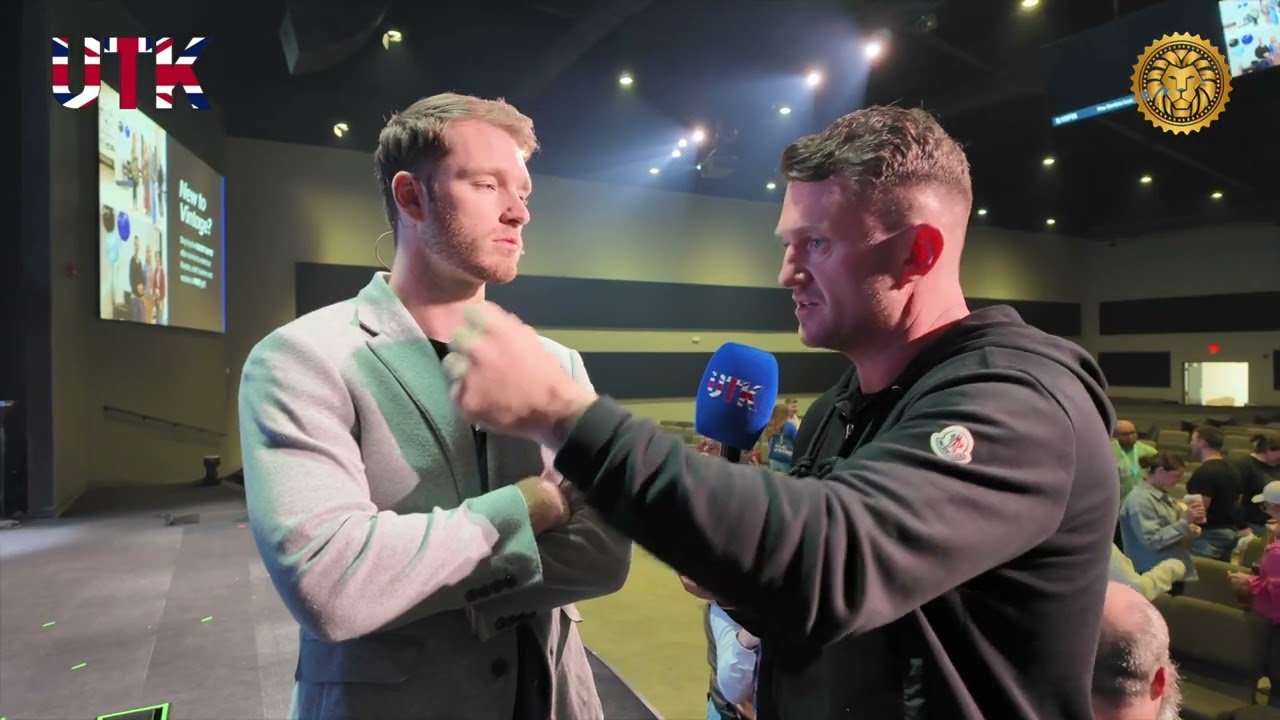
Tommy Robinson interviews Pastor Daniel Hayworth, uncovering a bold movement of "Christian Constitutionalists" who refuse to remain silent in the face of spiritual and cultural threats. By contrasting the life and legacy of Jesus with that of Muhammad, Daniel sounds a clarion call for believers to reclaim their role in the public square, asserting that the survival of liberty and the American experiment depends entirely on a Church that is awake, educated, and unafraid.